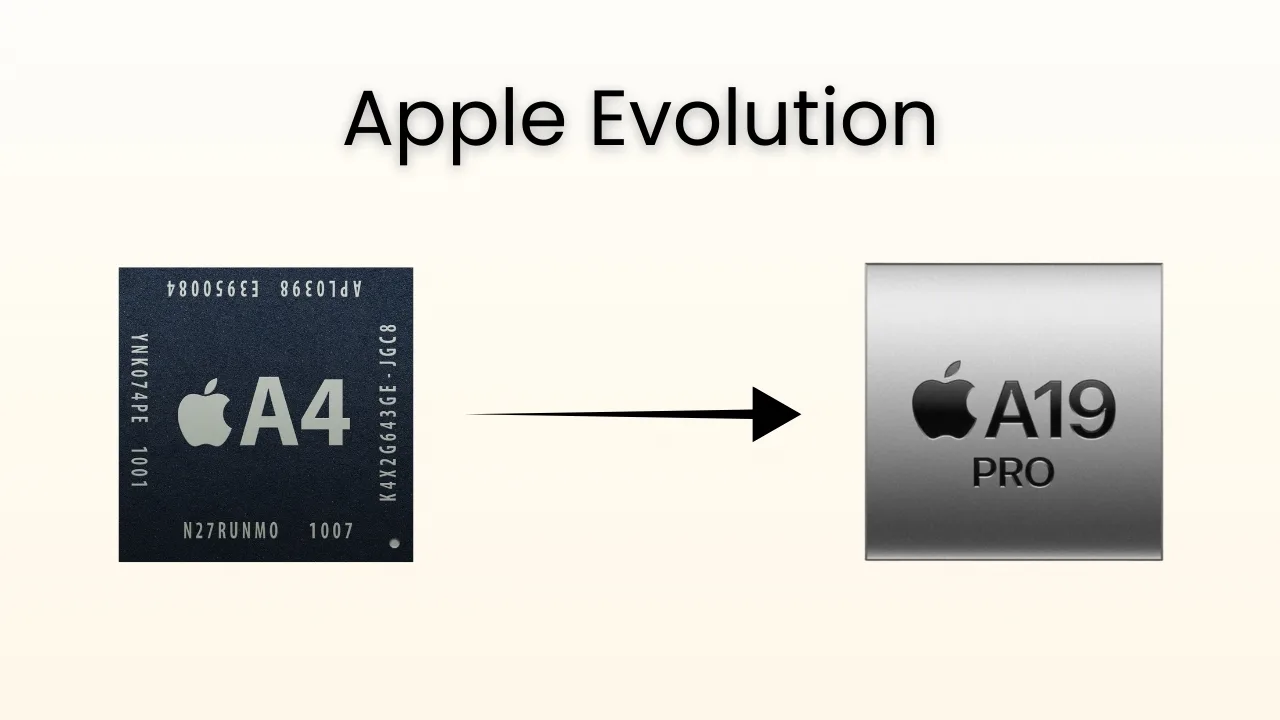
A-series Chip: From the A4 in 2010 to the A19 Pro in 2025, Apple’s A-series chips trace the evolution of iPhone power, AI, and efficiency. Here’s what the timeline really shows.
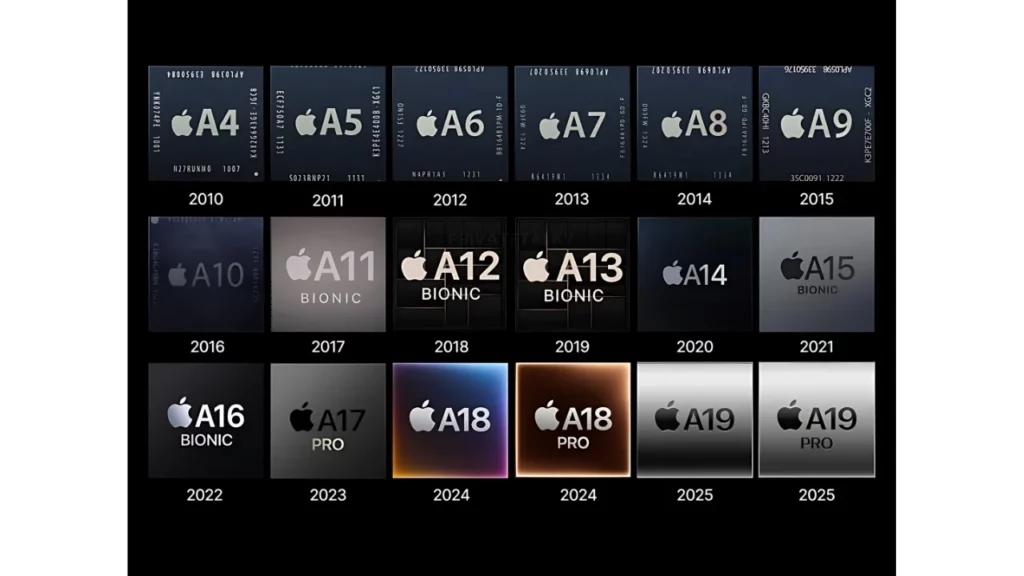
Fifteen years (and counting) of iPhone chips show more than just speed upgrades. From the A4 in 2010 to the A19 Pro in 2025, the A-series is the diary of how the iPhone learned to run faster, take better photos, and last longer. Hidden in that timeline is Apple’s quiet shift from raw power to a split path of standard and Pro chips that now shapes every iPhone.
The Foundational Era (A4 → A10): control and efficiency
A4 (2010) was Apple’s first in-house SoC (fabricated by Samsung), giving Apple end-to-end control over performance and battery life. A5 (2011) brought dual-core smoothness; A6 (2012) introduced Apple’s first fully custom CPU cores; and A7 (2013) shocked rivals as the first 64-bit smartphone chip. A8 (2014) leaned into efficiency to enable larger iPhones. A9 (2015) amped up CPU/GPU for Live Photos and 4K video. A10 Fusion (2016) debuted Apple’s 2-performance/2-efficiency core design to balance speed and endurance an approach that still underpins modern chips.
The Bionic Era (A11 → A16): silicon gets “smart”
A11 Bionic (2017) added the Neural Engine (≈0.6 TOPS) to power Face ID, AR, and on-device ML. A12 (2018) moved to 7nm and a much faster 5 TOPS Neural Engine, enabling Smart HDR and more advanced computational photography. A14 (2020) became the first 5-nm smartphone chip with a 16-core Neural Engine, and iPhone 12 brought 5G. A15 (2021) added a 5-core GPU on Pro for ProRes video. A16 (2022) refined efficiency (4-nm-class process) and powered the Always-On display and Dynamic Island on iPhone 14 Pro.
The Split Era (A17 Pro → A19 Pro): standard vs. Pro silicon
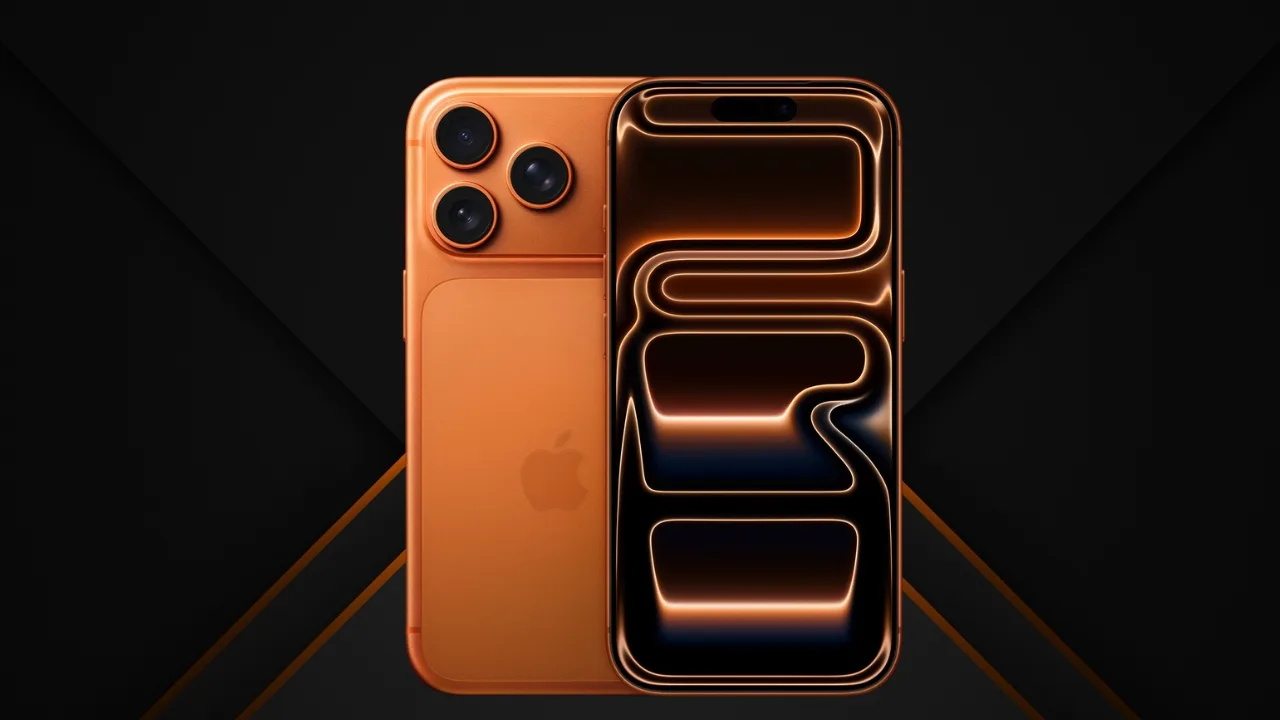
A17 Pro (2023) launched on 3nm and introduced hardware-accelerated ray tracing. In 2024, iPhone 16/16 Plus got A18, while Pro models got A18 Pro, tuned for higher GPU and pro-workflow headroom (Apple-quoted: ~15% CPU, ~20% GPU, 2× RT vs A17 Pro). In 2025, iPhone 17 uses A19, while iPhone Air and 17 Pro/Pro Max use A19 Pro with Apple claiming up to 40% better sustained performance on Pro thanks to a vapor-chamber and a redesigned 6-core GPU with per-core neural accelerators.
The power curve (grounded numbers):
- A18 vs A16: ~30% faster CPU, ~40% faster GPU (Apple’s own comparisons).
- A18 Pro vs A17 Pro: up to 15% CPU, 20% GPU, 2× hardware RT (Apple-quoted).
- A19 Pro vs A18 Pro: about 11–12% CPU and ~37% GPU uplift; N3P process + micro-arch changes drive the gains.
AI, in real life
Neural Engine throughput scaled from ~0.6 TOPS (A11) to ~5 TOPS (A12) to ~35 TOPS (A17 Pro/A18) the invisible muscle behind cleaner low-light photos, on-device transcription, and smarter edits. A19 Pro extends this with larger caches and neural accelerators inside each GPU core to help run local language models and creative tools more smoothly.
Creator note (spatial video)
iPhone 16/17 models record spatial video at 1080p/30fps for Vision Pro; iPhone 16 Pro also does 4K/120 Dolby Vision for standard video (not spatial). Keep those distinctions straight in captions.
The most powerful iPhone chip yet
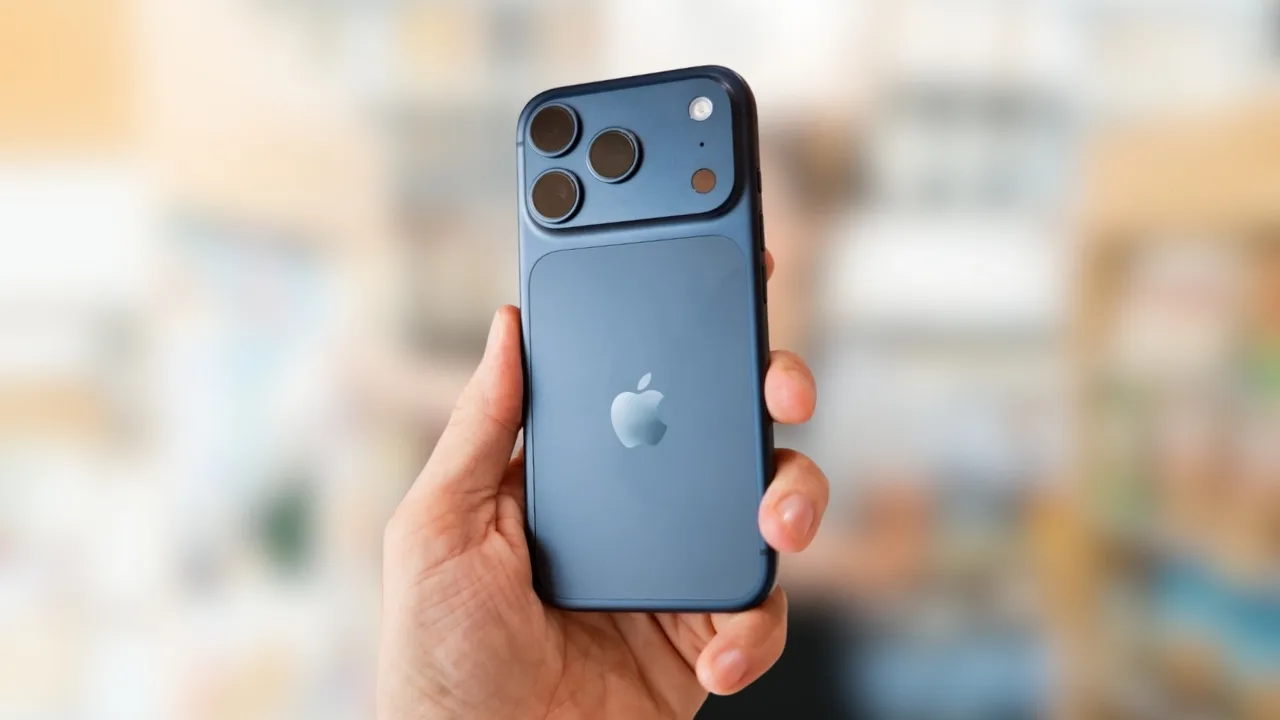
As of September 2025, A19 Pro is Apple’s most powerful iPhone chip. It leads in CPU, GPU, and creative workloads, with tighter Apple Intelligence integration and better sustained performance thanks to the N3P process, a redesigned 6-core GPU, and improved thermals on Pro models. In practice, that means smoother ray-traced games, faster 4K/ProRes edits, and more on-device generative AI without offloading to the cloud.
A19 Pro is the most capable iPhone chip to date, but the meaningful story is the split strategy: A-standard brings wide, efficient AI and great battery life to the mainstream, while A-Pro raises the ceiling for GPU-heavy apps, ray-traced games, and on-device generative AI. That’s the real arc your timeline is telling.